
Description
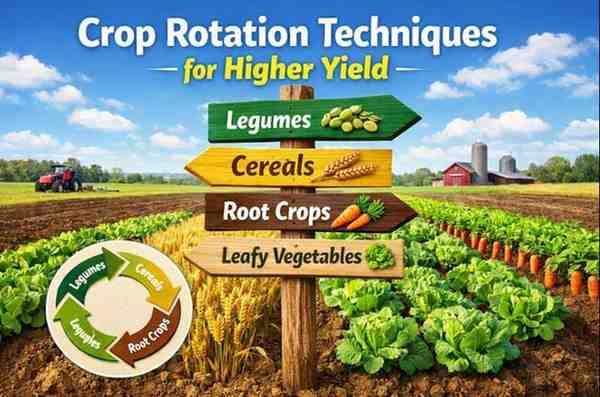
Modern agriculture faces growing challenges such as declining soil fertility, rising pest pressure, and increasing input costs. One of the most effective and time-tested solutions to these problems is crop rotation. When implemented correctly, crop rotation techniques for higher yield can significantly improve soil health, reduce crop losses, and increase farm profitability.
This article explains what crop rotation is, why it matters, and the best crop rotation techniques farmers can use to achieve higher and more sustainable yields.
What Is Crop Rotation?
Crop rotation is the agricultural practice of growing different crops sequentially on the same field instead of planting the same crop year after year. Each crop has unique nutrient requirements, rooting patterns, and pest interactions, which helps maintain soil balance and productivity.
Crop rotation is widely used in sustainable and regenerative farming systems.
Why Crop Rotation Is Important for Higher Yield
Continuous monocropping depletes soil nutrients and encourages pests and diseases. Crop rotation addresses these issues by:
-
Restoring soil fertility
-
Breaking pest and disease cycles
-
Improving soil structure
-
Enhancing nutrient availability
-
Reducing dependency on chemical inputs
Healthy soil leads directly to higher yields.
Key Benefits of Crop Rotation
Improved Soil Fertility
Leguminous crops fix atmospheric nitrogen, enriching soil naturally.
Better Pest and Disease Control
Rotating crops interrupts the life cycles of crop-specific pests and pathogens.
Enhanced Water and Nutrient Use
Different root systems improve soil aeration and water retention.
Higher Long-Term Productivity
Balanced nutrient use prevents soil exhaustion and yield decline.
Best Crop Rotation Techniques for Higher Yield
1. Cereal–Legume Rotation
This is one of the most effective and commonly used crop rotation systems.
Example:
-
Rice → Chickpea
-
Maize → Moong
Benefits:
-
Legumes add nitrogen to the soil
-
Reduced fertilizer requirement
-
Improved yield of subsequent cereal crops
2. Deep-Rooted and Shallow-Rooted Crop Rotation
Alternating crops with different root depths improves soil structure.
Example:
-
Cotton (deep-rooted) → Wheat (shallow-rooted)
Benefits:
-
Improved nutrient extraction from different soil layers
-
Better soil aeration and drainage
3. Heavy Feeder and Light Feeder Rotation
Crops are rotated based on nutrient consumption.
Example:
-
Potato (heavy feeder) → Pulses or millets (light feeders)
Benefits:
-
Prevents nutrient depletion
-
Balanced fertilizer usage
4. Pest and Disease Break Rotation
Rotating crops from different botanical families reduces pest buildup.
Example:
-
Tomato → Mustard
-
Sugarcane → Pulses
Benefits:
-
Lower pest and disease pressure
-
Reduced pesticide costs
5. Cereal–Oilseed–Pulse Rotation
A three-crop rotation system that maximizes land use efficiency.
Example:
-
Rice → Mustard → Moong
Benefits:
-
Year-round land utilization
-
Improved soil health
-
Higher annual income
6. Green Manure Crop Rotation
Including green manure crops enhances soil organic matter.
Example:
-
Dhaincha or Sunhemp before main crop
Benefits:
-
Improved soil fertility
-
Enhanced microbial activity
-
Reduced chemical fertilizer requirement
7. Seasonal Crop Rotation (Kharif–Rabi–Zaid)
Utilizing all seasons improves productivity per acre.
Example:
-
Kharif: Maize
-
Rabi: Wheat
-
Zaid: Moong
Benefits:
-
Maximum cropping intensity
-
Better resource utilization
-
Higher overall yield
Crop Rotation Planning Based on Soil Type
Sandy Soils
-
Millets, pulses, groundnut
-
Frequent rotation to maintain fertility
Clay Soils
-
Rice, wheat, mustard
-
Rotation improves drainage and structure
Loamy Soils
-
Ideal for diversified rotations
-
Supports cereals, pulses, oilseeds, and vegetables
Common Mistakes to Avoid in Crop Rotation
-
Repeating crops from the same family
-
Ignoring soil nutrient status
-
Poor timing of sowing and harvesting
-
Overlooking market demand
Balanced planning is essential.
Role of Crop Rotation in Sustainable Farming
Crop rotation supports:
-
Reduced chemical input dependency
-
Climate-resilient farming
-
Improved biodiversity
-
Long-term soil health
It is a cornerstone of sustainable and regenerative agriculture.
How Crop Rotation Improves Farm Profitability
Higher yields and lower costs result from:
-
Reduced fertilizer and pesticide use
-
Improved crop resilience
-
Stable long-term productivity
This directly increases net farm income.
Summary
Adopting effective crop rotation techniques for higher yield is one of the smartest decisions farmers can make. By rotating crops strategically, farmers can improve soil health, control pests naturally, and achieve consistent yield improvement over time.
Crop rotation is not just a traditional practice—it is a modern solution for profitable and sustainable agriculture.


Reviews
There are no reviews yet.