
Description
Modern agriculture is no longer limited to crop production alone. Today, food and agricultural products pass through multiple interconnected stages before reaching consumers. This interconnected system is known as the agribusiness value chain, and understanding it is essential for improving efficiency, profitability, and sustainability in agriculture.
This article explains the agribusiness value chain, its components, importance, and role in strengthening agricultural markets.
What Is the Agribusiness Value Chain?
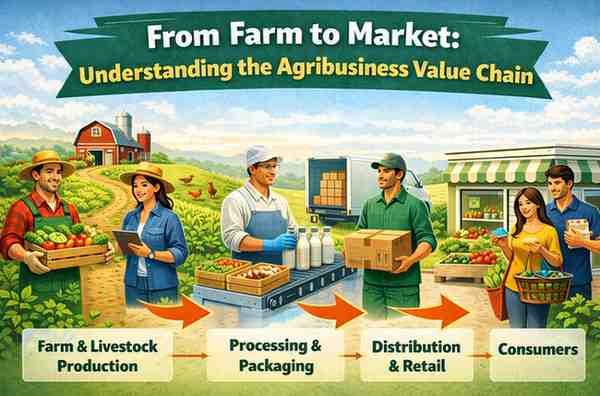
The agribusiness value chain refers to the entire sequence of activities involved in producing, processing, transporting, marketing, and distributing agricultural products. Each stage adds value to the product, increasing its usefulness, quality, and market price.
The goal of the value chain is to deliver high-quality agricultural products to consumers while maximizing returns for all stakeholders.
Key Stages of the Agribusiness Value Chain
The agribusiness value chain is made up of several interdependent stages:
1. Input Supply Stage
This is the foundation of the value chain.
Includes:
-
Seeds and planting materials
-
Fertilizers and crop protection products
-
Farm machinery and tools
-
Irrigation systems and technology
Efficient input supply improves productivity and crop quality.
2. Farm Production Stage
This stage involves actual agricultural production.
Activities Include:
-
Crop cultivation
-
Livestock rearing
-
Fisheries and aquaculture
-
Harvesting operations
Farm-level efficiency determines the overall quality of output.
3. Post-Harvest Handling and Storage
Proper post-harvest management prevents losses.
Key Activities:
-
Cleaning and grading
-
Drying and storage
-
Cold storage and warehousing
-
Quality preservation
This stage is critical for reducing waste and maintaining value.
4. Processing and Value Addition
Processing transforms raw produce into consumer-ready products.
Examples:
-
Milling grains into flour
-
Milk processing into dairy products
-
Fruit processing into juices and jams
Value addition significantly increases profitability.
5. Transportation and Logistics
Efficient logistics connect producers to markets.
Includes:
-
Cold chain logistics
-
Packaging and handling
-
Distribution networks
Strong logistics reduce delays and spoilage.
6. Marketing and Retailing
This stage delivers products to consumers.
Channels Include:
-
Wholesale markets
-
Retail stores and supermarkets
-
Online and direct-to-consumer platforms
Marketing determines final pricing and demand.
Supporting Services in the Agribusiness Value Chain
Several support systems enable smooth value chain functioning.
Key Support Services
-
Financial institutions and credit
-
Insurance and risk management
-
Extension services and training
-
Digital platforms and agri-tech solutions
-
Quality certification and standards
These services improve resilience and transparency.
Importance of the Agribusiness Value Chain
A strong agribusiness value chain benefits all participants.
Benefits for Farmers
-
Better market access
-
Higher price realization
-
Reduced post-harvest losses
Benefits for Consumers
-
Consistent quality
-
Food safety and traceability
-
Stable supply
Benefits for the Economy
-
Employment generation
-
Export growth
-
Food security
Role of Technology in Strengthening the Value Chain
Technology is transforming agribusiness value chains.
Key Innovations:
-
Digital marketplaces
-
Blockchain for traceability
-
Cold chain technology
-
Data-driven demand forecasting
Technology enhances efficiency and reduces inefficiencies.
Agribusiness Value Chain in Developing Economies
In developing countries, value chain development is critical for:
-
Reducing rural poverty
-
Integrating small farmers into markets
-
Enhancing competitiveness
Public-private partnerships play a vital role.
Common Challenges in Agribusiness Value Chains
Despite its importance, the value chain faces challenges:
-
Infrastructure gaps
-
Price volatility
-
Limited access to finance
-
Information asymmetry
Addressing these issues improves value distribution.
Strategies to Improve Agribusiness Value Chain Efficiency
-
Strengthen farmer organizations
-
Invest in storage and processing infrastructure
-
Promote contract farming and aggregation
-
Encourage digital integration
-
Improve policy and regulatory support
Efficiency benefits all stakeholders.
Future Outlook of Agribusiness Value Chains
With rising demand for quality, traceable, and sustainable food products, agribusiness value chains will continue to evolve. Integrated, technology-driven value chains will dominate future agricultural systems.
Summary
Understanding the agribusiness value chain is essential for transforming agriculture into a profitable and sustainable industry. From input suppliers to consumers, every link plays a critical role in creating value.
Strengthening each stage of the value chain ensures better income for farmers, improved food quality for consumers, and long-term agricultural growth.



Reviews
There are no reviews yet.