
Description
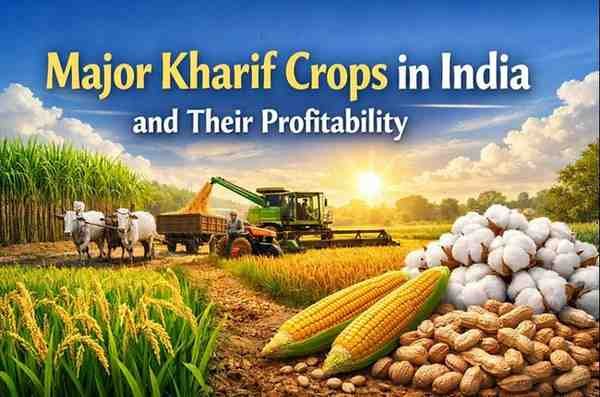
Agriculture plays a vital role in India’s economy, and Kharif crops form a significant share of the country’s total agricultural output. Grown during the monsoon season, Kharif crops depend heavily on rainfall and are crucial for farmer income, food security, and agro-based industries. Understanding the major Kharif crops in India and their profitability helps farmers, agribusiness investors, and policymakers make informed decisions.
This article explores the main Kharif crops, their cultivation regions, input costs, yield potential, and profitability.
What Are Kharif Crops?
Kharif crops are sown at the beginning of the southwest monsoon, typically between June and July, and harvested between September and October. These crops require warm weather and adequate rainfall.
Examples include rice, maize, cotton, soybean, pulses, and oilseeds.
Importance of Kharif Crops in India
Kharif crops are essential because they:
-
Contribute significantly to India’s food grain production
-
Support rural employment and farmer livelihoods
-
Supply raw materials for textile, oil, and food industries
-
Influence inflation and food prices
A successful Kharif season has a direct impact on the Indian economy.
Major Kharif Crops in India
1. Rice (Paddy)
Major Producing States: West Bengal, Uttar Pradesh, Punjab, Andhra Pradesh, Odisha, Tamil Nadu
Water Requirement: High
Profitability Overview:
Rice is India’s most important Kharif crop and a staple food for millions. Profitability depends on irrigation access, government MSP (Minimum Support Price), and yield per hectare.
Pros:
-
Assured government procurement
-
Stable market demand
Challenges:
-
High water usage
-
Rising input costs
2. Maize
Major Producing States: Karnataka, Madhya Pradesh, Bihar, Telangana, Andhra Pradesh
Water Requirement: Moderate
Profitability Overview:
Maize is increasingly profitable due to demand from poultry feed, food processing, and ethanol blending programs.
Pros:
-
Short crop duration
-
Lower water requirement than rice
Challenges:
-
Price fluctuations
-
Pest management issues
3. Cotton
Major Producing States: Maharashtra, Gujarat, Telangana, Andhra Pradesh, Punjab
Water Requirement: Moderate to high
Profitability Overview:
Cotton is one of the most commercially valuable Kharif crops. Profit margins are higher in regions with Bt cotton and good pest control.
Pros:
-
High market value
-
Strong export demand
Challenges:
-
Pest infestation risks
-
High input and labor costs
4. Soybean
Major Producing States: Madhya Pradesh, Maharashtra, Rajasthan
Water Requirement: Moderate
Profitability Overview:
Soybean is a major oilseed crop with strong demand from edible oil and animal feed industries.
Pros:
-
Low cultivation cost
-
Improves soil fertility through nitrogen fixation
Challenges:
-
Dependence on timely rainfall
-
Disease susceptibility
5. Groundnut
Major Producing States: Gujarat, Andhra Pradesh, Tamil Nadu, Karnataka
Water Requirement: Moderate
Profitability Overview:
Groundnut is valued for its oil and food uses. Profitability improves with improved seed varieties and mechanization.
Pros:
-
High oil content
-
Good export potential
Challenges:
-
Weather sensitivity
-
Post-harvest losses
6. Bajra (Pearl Millet)
Major Producing States: Rajasthan, Maharashtra, Gujarat, Uttar Pradesh
Water Requirement: Low
Profitability Overview:
Bajra is highly suitable for dry and semi-arid regions. With rising demand for millets, its profitability is increasing.
Pros:
-
Drought-resistant
-
Low input costs
Challenges:
-
Limited market awareness in some regions
7. Jowar (Sorghum)
Major Producing States: Maharashtra, Karnataka, Telangana
Water Requirement: Low
Profitability Overview:
Jowar is gaining popularity due to its nutritional value and use in health foods.
Pros:
-
Climate-resilient crop
-
Suitable for rainfed farming
Challenges:
-
Lower yields compared to rice and maize
8. Pulses (Arhar, Moong, Urad)
Major Producing States: Maharashtra, Madhya Pradesh, Uttar Pradesh, Rajasthan
Water Requirement: Low to moderate
Profitability Overview:
Pulses are increasingly profitable due to high protein demand and government support.
Pros:
-
Low fertilizer requirement
-
Improves soil health
Challenges:
-
Yield variability
-
Pest management
Factors Affecting Profitability of Kharif Crops
Several factors determine profitability:
-
Rainfall distribution and climate conditions
-
Input costs (seeds, fertilizers, labor)
-
Market prices and MSP availability
-
Access to irrigation and technology
-
Government schemes and subsidies
Crop diversification and risk management play a key role.
Most Profitable Kharif Crops (General Comparison)
| Crop | Investment Level | Profit Potential |
|---|---|---|
| Cotton | High | High |
| Soybean | Low–Moderate | High |
| Maize | Moderate | Moderate–High |
| Pulses | Low | Moderate |
| Millets | Low | Moderate |
Profitability varies by region and farming practices.
Future Outlook for Kharif Crops in India
With increasing focus on:
-
Climate-resilient farming
-
Millet promotion
-
Oilseed self-sufficiency
-
Agri-technology adoption
Kharif crops are expected to become more diversified and profitable in the coming years.
Summary
Understanding the major Kharif crops in India and their profitability is essential for sustainable farming and income stability. While traditional crops like rice and cotton remain important, emerging demand for maize, pulses, oilseeds, and millets is reshaping profitability trends.
Strategic crop selection, efficient resource use, and market awareness can significantly improve farmer income during the Kharif season.



Reviews
There are no reviews yet.