
Description
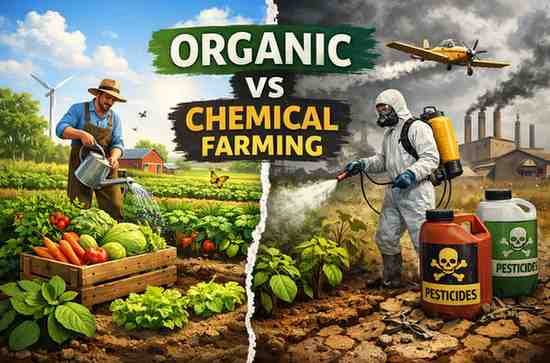
Choosing the right farming approach is one of the most important decisions in agriculture today. With rising concerns about food safety, environmental sustainability, and farm profitability, the debate between organic farming and conventional farming has become increasingly relevant. This article presents a clear, practical comparison to help readers understand how these two systems differ and which may be more suitable under different conditions.
Understanding Organic and Conventional Farming
Before comparing the two, it is important to understand their basic concepts.
What Is Organic Farming?
Organic farming is an agricultural system that uses natural inputs and biological processes to grow crops and raise livestock. It avoids synthetic fertilizers, chemical pesticides, genetically modified seeds, and artificial growth enhancers.
What Is Conventional Farming?
Conventional farming relies on chemical fertilizers, synthetic pesticides, herbicides, and high-yield seed varieties to maximize production. It focuses on short-term productivity and large-scale output.
Key Differences Between Organic and Conventional Farming
1. Inputs Used
-
Organic Farming: Compost, green manure, bio-fertilizers, natural pest control
-
Conventional Farming: Chemical fertilizers, pesticides, herbicides
Organic inputs enhance soil life, while chemical inputs deliver fast nutrient availability.
2. Soil Health and Fertility
-
Organic Farming: Improves soil structure and microbial activity over time
-
Conventional Farming: May degrade soil health with prolonged chemical use
Healthy soil is central to sustainable agriculture.
3. Crop Yield
-
Organic Farming: Moderate yields, especially during initial years
-
Conventional Farming: High yields in the short term
Yield differences often reduce as organic systems mature.
4. Environmental Impact
-
Organic Farming: Low environmental pollution and better biodiversity
-
Conventional Farming: Higher risk of soil, water, and air pollution
Organic methods support ecosystem balance.
5. Pest and Disease Management
-
Organic Farming: Biological controls and crop rotation
-
Conventional Farming: Chemical pesticides and herbicides
Organic systems emphasize prevention rather than cure.
6. Cost of Cultivation
-
Organic Farming: Lower input costs but higher labor requirements
-
Conventional Farming: Higher input costs with lower labor needs
Cost structures differ significantly.
7. Food Quality and Safety
-
Organic Farming: Chemical-free, often higher nutrient density
-
Conventional Farming: May contain pesticide residues within permissible limits
Consumer preference is shifting toward organic food.
8. Market Value and Pricing
-
Organic Farming: Premium pricing and niche markets
-
Conventional Farming: Standard market prices
Market access plays a critical role in profitability.
Organic vs Conventional Farming: Quick Comparison Table
| Aspect | Organic Farming | Conventional Farming |
|---|---|---|
| Fertilizers | Natural | Synthetic |
| Pest Control | Biological | Chemical |
| Soil Health | Improves long-term | Often degrades |
| Yield | Moderate | High |
| Environmental Impact | Low | High |
| Market Price | Premium | Regular |
| Sustainability | High | Moderate |
Advantages of Organic Farming
-
Environmentally sustainable
-
Improves long-term soil fertility
-
Growing consumer demand
-
Better farm resilience
Advantages of Conventional Farming
-
High productivity
-
Faster crop growth
-
Suitable for large-scale food supply
-
Lower labor requirements
Challenges of Both Farming Systems
Organic Farming Challenges
-
Transition period
-
Certification costs
-
Skilled management required
Conventional Farming Challenges
-
Environmental degradation
-
Rising input costs
-
Resistance to pests and weeds
Which Farming System Is Better?
There is no one-size-fits-all answer. The choice depends on:
-
Farm size
-
Climate and soil conditions
-
Market access
-
Farmer goals and resources
In many cases, integrated and sustainable farming practices that combine the strengths of both systems offer the best outcomes.
Future of Farming Systems
With increasing focus on sustainability, climate resilience, and food safety, organic and eco-friendly farming systems are expected to grow. At the same time, conventional farming will continue evolving with improved efficiency and reduced environmental impact.
Summary
The comparison between organic and conventional farming highlights the trade-off between short-term productivity and long-term sustainability. Understanding these differences helps farmers, consumers, and policymakers make informed decisions.
Balanced, science-based approaches will shape the future of agriculture.

Reviews
There are no reviews yet.