
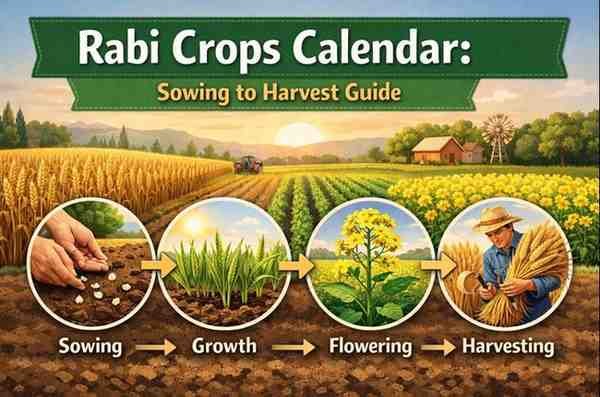
Description
India’s agricultural cycle is broadly divided into Kharif, Rabi, and Zaid seasons. Among these, Rabi crops play a critical role in ensuring food security, farmer income, and market stability during the winter months. A well-planned Rabi crops calendar helps farmers optimize sowing time, input use, and harvesting schedules to maximize yield and profitability.
This guide provides a complete sowing-to-harvest calendar for major Rabi crops in India, along with practical insights.
What Are Rabi Crops?
Rabi crops are sown after the southwest monsoon, typically between October and November, and harvested between March and April. These crops require cool temperatures during growth and warm, dry conditions at maturity.
Common Rabi crops include wheat, barley, mustard, gram, peas, and lentils.
Importance of the Rabi Crops Calendar
Following a proper Rabi crop calendar helps farmers:
-
Achieve timely sowing and uniform germination
-
Optimize water and fertilizer use
-
Reduce pest and disease risks
-
Plan labor and machinery efficiently
-
Improve overall crop yield and quality
Timeliness is a key factor in Rabi crop success.
Rabi Crops Calendar: Month-by-Month Overview
| Activity | Time Period |
|---|---|
| Land Preparation | September – October |
| Sowing | October – November |
| Vegetative Growth | November – January |
| Flowering & Grain Formation | January – February |
| Maturity & Harvest | March – April |
Major Rabi Crops and Their Sowing-to-Harvest Timeline
1. Wheat
Sowing Time: Mid-October to Mid-November
Harvest Time: March to April
Key Practices:
-
Well-prepared, irrigated fields
-
Timely nitrogen application
-
Adequate weed control during early growth
Wheat is India’s most important Rabi crop.
2. Barley
Sowing Time: Late October to November
Harvest Time: March
Key Practices:
-
Suitable for marginal soils
-
Requires less irrigation than wheat
-
Tolerant to saline conditions
Barley is gaining demand from food and beverage industries.
3. Mustard (Rapeseed)
Sowing Time: October
Harvest Time: February to March
Key Practices:
-
Well-drained soils
-
Timely irrigation during flowering
-
Pest monitoring for aphids
Mustard is a major Rabi oilseed crop.
4. Gram (Chickpea)
Sowing Time: October to Early November
Harvest Time: February to March
Key Practices:
-
Minimal irrigation
-
Rhizobium inoculation for better nitrogen fixation
-
Disease-resistant varieties preferred
Gram is a low-input, high-demand pulse crop.
5. Lentil (Masur)
Sowing Time: October
Harvest Time: March
Key Practices:
-
Grows well in residual soil moisture
-
Requires minimal fertilizer
-
Sensitive to waterlogging
Lentils contribute to soil fertility and nutrition.
6. Peas
Sowing Time: October to November
Harvest Time: February to March
Key Practices:
-
Well-drained loamy soils
-
Timely irrigation during flowering
-
Suitable for both vegetable and grain use
Peas are popular for domestic consumption.
7. Oats
Sowing Time: October to November
Harvest Time: February to March
Key Practices:
-
Used as fodder and grain
-
Requires moderate irrigation
-
Fast-growing crop
Oats are widely grown for livestock feed.
Irrigation Schedule for Rabi Crops
Since Rabi crops depend largely on irrigation, water management is crucial.
Critical Irrigation Stages
-
Crown root initiation (wheat)
-
Flowering stage (oilseeds and pulses)
-
Grain filling stage
Over-irrigation should be avoided to prevent disease and nutrient loss.
Fertilizer and Nutrient Management
Proper nutrient management improves yield and soil health.
Best Practices
-
Soil testing before sowing
-
Balanced NPK application
-
Use of organic manure or compost
-
Micronutrient supplementation where required
Integrated nutrient management is recommended.
Pest and Disease Management
Common Rabi pests include aphids, termites, and cutworms.
Preventive Measures
-
Timely sowing
-
Crop rotation
-
Use of certified seeds
-
Regular field monitoring
Early detection reduces crop losses.
Harvesting and Post-Harvest Handling
Timely harvesting ensures better grain quality.
Harvest Tips
-
Harvest when grains are hard and dry
-
Avoid delayed harvesting to reduce shattering
-
Proper drying before storage
Good post-harvest practices reduce losses and improve market value.
Common Mistakes to Avoid in Rabi Farming
-
Delayed sowing
-
Excessive irrigation
-
Imbalanced fertilizer use
-
Poor weed control
Avoiding these mistakes leads to higher productivity.
Future Outlook for Rabi Crops in India
With advancements in:
-
High-yielding varieties
-
Precision irrigation
-
Climate-resilient practices
Rabi crop productivity is expected to improve further, ensuring food security and farmer income stability.
Summary
A well-structured Rabi crops calendar from sowing to harvest is essential for successful winter crop cultivation in India. By following timely operations, efficient water use, and balanced nutrient management, farmers can achieve higher yields and better profitability.
Understanding the Rabi crop cycle empowers farmers to plan effectively and farm sustainably.



Reviews
There are no reviews yet.