

Description
Small landholdings dominate agriculture in many countries, especially in India. While limited land size often restricts traditional farming income, agribusiness opportunities for small farmers are transforming small farms into profitable, sustainable enterprises. By focusing on value addition, market linkage, and smart resource use, small farmers can significantly increase their earnings.
This article explains how agribusiness can empower small farmers and outlines practical strategies for success.
Understanding Agribusiness for Small Farmers
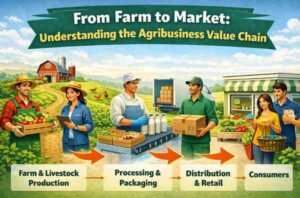
Agribusiness for small farmers involves integrating farming with business-oriented activities such as processing, packaging, direct marketing, and service provision. Instead of selling raw produce at low prices, farmers participate in higher-value stages of the agricultural value chain.
The focus shifts from production alone to profitability and market demand.
Why Agribusiness Is Ideal for Small Farmers
Small farmers face challenges like limited land, fluctuating prices, and rising input costs. Agribusiness helps overcome these barriers.
Key Advantages
-
Higher income per unit of land
-
Reduced dependence on middlemen
-
Better price realization
-
Diversified income sources
Even small-scale initiatives can deliver significant returns.
High-Potential Agribusiness Models for Small Farmers
1. Value-Added Farm Products
Processing farm produce improves shelf life and margins.
Examples:
-
Pickles, jams, and sauces
-
Flour and spice powders
-
Dried fruits and vegetables
These businesses require low investment and small space.
2. Organic and Natural Farming Enterprises
Organic products command premium prices in urban markets.
Suitable For:
-
Vegetables and fruits
-
Pulses and millets
-
Spices and herbs
Certification and branding enhance profitability.
3. Direct-to-Consumer (D2C) Farming
Selling directly to consumers eliminates intermediaries.
Channels Include:
-
Local farmers’ markets
-
Online platforms
-
Community-supported agriculture (CSA)
This model improves price control and customer trust.
4. Mushroom and Microgreen Farming
These enterprises require minimal land and water.
Benefits:
-
Fast crop cycles
-
High market demand
-
Suitable for indoor cultivation
Ideal for marginal farmers and youth.
5. Dairy and Small Livestock Farming
Livestock provides regular cash flow.
Options:
-
Dairy farming
-
Goat and sheep rearing
-
Poultry units
Integrated farming increases resilience.
6. Beekeeping and Allied Activities
Beekeeping enhances crop yield through pollination.
Income Sources:
-
Honey and wax
-
Value-added honey products
-
Pollination services
Low investment, high ecological benefits.
Role of Farmer Producer Organizations (FPOs)
Collective farming and marketing strengthen small farmers.
How FPOs Help
-
Bulk input procurement
-
Collective marketing
-
Better bargaining power
-
Access to credit and technology
FPOs make agribusiness scalable.
Use of Technology in Small-Scale Agribusiness
Digital tools are transforming rural enterprises.
Examples:
-
Mobile-based market information
-
Precision farming tools
-
Digital payments and e-commerce
-
Online advisory services
Technology reduces inefficiencies.
Government Support for Small Farmers
Many governments support small farmers through:
-
Subsidies and grants
-
Low-interest loans
-
Skill development programs
-
Crop insurance schemes
Leveraging these schemes improves success rates.
Key Challenges and How to Overcome Them
Common Challenges
-
Limited capital
-
Lack of market access
-
Skill gaps
Practical Solutions
-
Start small and scale gradually
-
Partner with cooperatives or FPOs
-
Invest in training and market research
Planning is critical.
Profitability Tips for Small Farmer Agribusiness
-
Focus on niche, high-demand products
-
Minimize wastage
-
Maintain consistent quality
-
Build a local brand identity
-
Diversify income streams
Smart decisions lead to sustainable growth.
Future Scope of Agribusiness for Small Farmers
With increasing demand for quality food, traceability, and sustainability, agribusiness offers a promising future. Small farmers who adopt entrepreneurial thinking and market-oriented practices can compete effectively in modern agricultural markets.
Summary
Agribusiness is not limited by land size—it is driven by innovation, value addition, and market linkage. By adopting agribusiness models tailored to their resources, small farmers can improve income, reduce risk, and achieve long-term stability.
Turning small farms into profitable enterprises is possible with the right approach.



Reviews
There are no reviews yet.